
Pick the track that starts your IT career
Hands-on online courses in cybersecurity, DevOps, and AI. Compare the three tracks, see how labs and certification prep run, and choose where to begin.
Tell us your current role and weekly study time. We map it to a track and send the syllabus.
Request syllabus- Cybersecurity
- DevOps & Cloud
- AI & AI Governance
- Orientation
- Foundations
- Labs open
- Cert prep
- Portfolio
- Interview prep
Three tracks, one way of working
Every track runs on the same rhythm: short lessons, then a lab you finish on your own machine, then a review of what you built. You are not watching a course. You are working through tasks and getting feedback on them.
Cybersecurity
Network defense, endpoint security, and incident response. You work in a virtual lab with real packet captures and practice the same steps a security analyst takes when triaging an alert. Prepares you for entry-level certification exams without promising a specific score.
See the cybersecurity trackDevOps & Cloud
Build pipelines, containers, and cloud infrastructure from a clean starting point. You deploy a service, break it on purpose, then fix it and document the rollback. Covers the tooling employers list most often in junior DevOps roles.
See the DevOps & cloud trackAI & AI Governance
Learn how models are trained, evaluated, and governed inside an organization. You write a model card, set evaluation criteria, and argue a policy position in writing. Built for people who will review AI decisions rather than train models themselves.
See the AI & governance track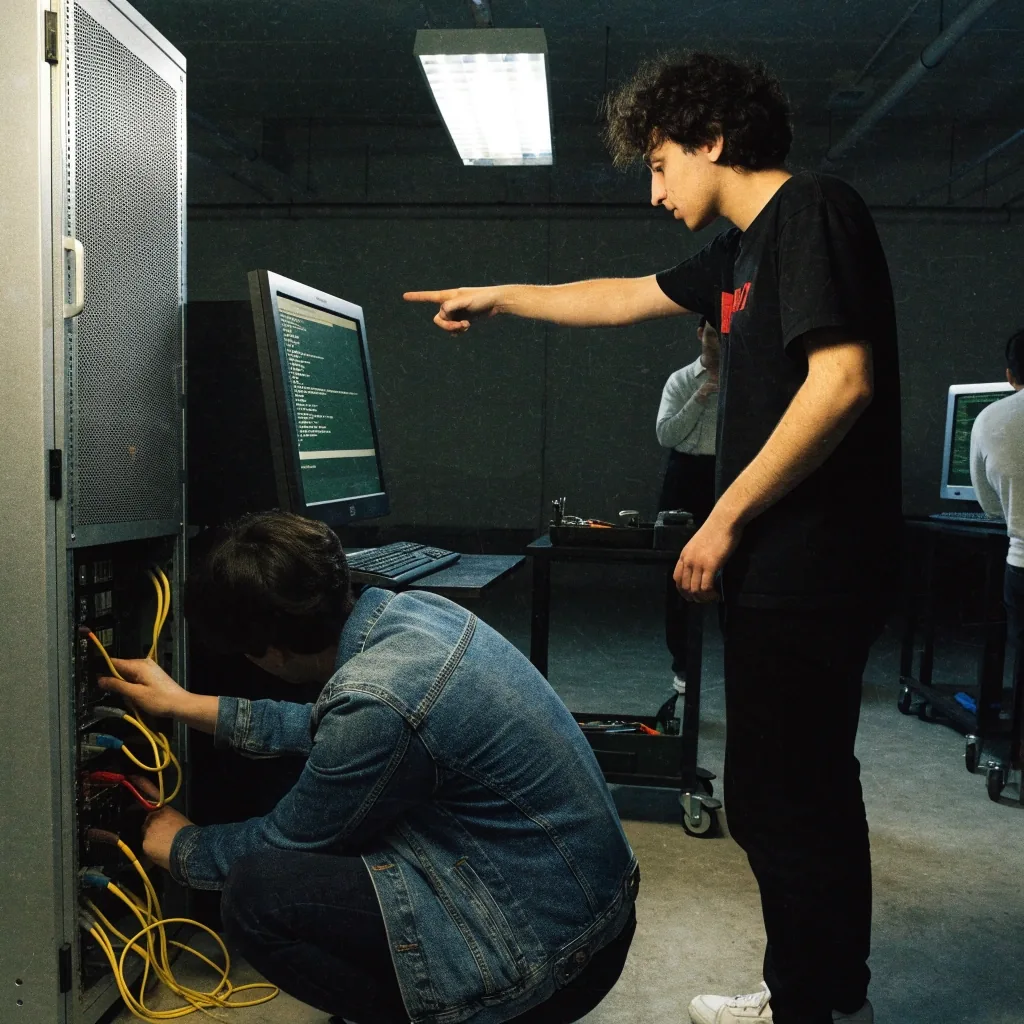
You finish each week with something you built
Labs are the point, not a bonus module. Each week opens with a short briefing, then hands you a task in a sandboxed environment. You configure, break, and repair it yourself. A reviewer reads what you submit and writes back with specific notes — where your approach was sound, and where a real environment would push back.
Nothing is graded on speed. If a lab takes you three evenings instead of one, that is normal and expected for a working adult switching fields.
How the tracks compare
A side-by-side read of the three paths. If you are changing careers, the cybersecurity row is usually the easiest entry point. If you already work near servers or code, the DevOps row builds on what you have.
Cybersecurity
Best if you are new to IT or moving from a support or helpdesk role. Focus on network defense, endpoint security, and incident response, with entry-level certification prep woven through the labs.
DevOps & Cloud
Best if you already touch servers, scripts, or code and want to move toward pipelines and infrastructure. Build CI pipelines, containerize a service, deploy it to cloud infrastructure, then practice rollback and monitoring. Weighs hands-on labs heavily.
AI & AI Governance
Best if your work touches policy, risk, compliance, or product decisions involving AI. Covers how models are trained and evaluated, how to document them, and how to write governance rules that hold up under review. Lighter on code than the other two tracks.
What a week actually looks like
Each track runs on a weekly spine. Lessons are self-paced and stay available; the review steps have soft deadlines so you keep moving. Here is the sequence a typical week follows.
Briefing and lab task
A short written briefing frames the week, then you receive your lab task. You know exactly what to build and what a finished result looks like before you start.
Build it in the sandbox
You work through the task at your own pace in a sandboxed environment. Most learners spend three to six hours here across a few evenings, depending on the track.
Written feedback on your work
Submit what you built and a reviewer reads it. Feedback points at specific decisions — what held up, what a real environment would break, and what to try next. This is not an automated score.
Add it to your portfolio
Every lab produces something you can show: a configuration, a pipeline, a model card, a written review. By the end of a track you have a body of work, not just a certificate of attendance.
Self-paced lessons, scheduled reviews
Lessons are available whenever you sit down. The parts that need a person — lab reviews, written feedback, and questions — run on a schedule you can see in advance. That mix is deliberate: it fits around a full-time job while still keeping you accountable to another human.
Lessons, readings, and lab sandboxes stay open for the length of your enrollment. Start a week on Sunday night or Wednesday morning.
Lab submissions are read in review windows. You get a target date up front and written feedback after each one.
Question threads run alongside each week. Ask about a specific error, a design choice, or where a topic shows up in real work.
You move through the same weekly spine as other learners on your track, so there is always someone at your stage to compare notes with.

Questions before you pick a track
Do I need IT experience to start?
Not for the cybersecurity track, which is built for career changers and people moving out of support roles. The DevOps track assumes you have touched servers, scripts, or code before. The AI & governance track assumes no coding background but expects you to read and write policy or risk material.
How much time should I set aside each week?
Most learners spend six to ten hours a week: two to four on lessons and four to six on the lab. If you can only manage four hours one week, you can still make progress — the lab deadlines are soft so you can catch up.
Do the courses prepare me for certification exams?
The cybersecurity track aligns its labs and readings with entry-level certification objectives so the material you practice is the material those exams cover. We do not sit the exams for you, promise a passing score, or hand out certificates on the vendor's behalf. You register and pay for the exam yourself when you feel ready.
What do I need on my own machine?
A laptop or desktop with a modern browser and a stable internet connection. Labs run in a hosted sandbox, so you do not need to install a heavy local environment. A second monitor helps but is not required.
Can I switch tracks after I start?
Yes, within the first two weeks of a track. Contact us with what you have completed and which track you want to move to, and we will carry over the work that maps across. After the first two weeks, switching means starting the new track's spine from the beginning.
How do I ask a question before enrolling?
Call +1-703-555-0826 during weekday business hours, or write to info@rob-in-hood.digital. Tell us your current role and how many hours a week you can study, and we will point you at the track that fits.
Start with the track that matches your next move
Read the track pages, compare what each one asks of your time and background, then get in touch if you want a second opinion before you enroll. We answer questions about fit before we talk about enrollment — that is the order that helps both of us.
Rob in Hood Digital
1200 Cyber Security Way
Reston, VA 20190, USA
Mon–Fri · 9:00 AM – 6:00 PM